Tipu, the Islamist tyrant in South India
Background
In recent times, Maharashtra and parts of North India have seen renewed debates around Tipu Sultan and his legacy, largely because of his wars against the British. But opposing the British alone does not automatically make someone a freedom fighter. Historical records suggest that Tipu Sultan, much like his father Hyder Ali, was driven by strong religious motives and carried out campaigns that involved large-scale violence, forced conversions, and persecution of Hindus. His image is far from universally respected in South India. In many regions, especially in Karnataka, Kerala, and parts of Tamil Nadu, he is remembered not as a hero, but as a ruler whose actions left behind a deep and painful legacy. There is a popular perception that South India remained largely isolated from the radical Islamists as the Mughal invaders could not advance up to the southern parts of the country. However, the atrocities of Hyder Ali, who usurped the throne of the Hindu Wodeyar kings of Mysore, and his son Tipu Sultan (1751-1799) present enough evidence to prove that radical Islamists had tried to further their religious fundamentalism in South India too. Unfortunately, thanks to Congress and its bunch of so-called secularist writers who masqueraded as historians for years, Tipu was, and is being, portrayed as a ‘freedom fighter’. Obviously, records state otherwise about his character. Tipu Sultan, who was ruler of Mysore from 1782 to 1799, conducted military campaigns involving documented violence against Hindus, temple destructions, forced religious conversions to Islam, and mass killings particularly during campaigns in Kerala (Malabar), Karnataka (including Coorg and Melkote), and parts of Tamil Nadu.
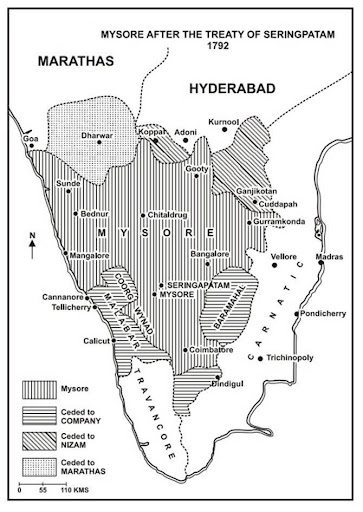
Mysore after the treaty of Seringapatam between the British and a defeated Tipu Sultan. The map shows the spread of Tipu Sultan’s Islamist fundamentalist rule. (* Source: Tipu: As He Really Was, by Gajanan Bhaskar Mehendale)
Tipu sought help from foreign powers to rule South India
As per various records, Tipu Sultan wanted to establish his domination over entire South India and project himself as the emperor of the vast territory. However, he felt that the British could prove to be the biggest hurdle in realising this, and hence he fought against the British. There was no Indian nationalistic motivation involved in his campaigns. He reached out to the French because he thought these European rivals could be interested in helping him out against the British. Also, he sought help from Turkey, Afghanistan, and Egypt to defeat the British. Had he been a nationalist to the core, he would have sought help from the kingdoms in North India and maintained friendly relations with them towards the common cause of protecting Indian territory against any foreign invader. In reality, he was a tyrant and a barbaric Islamist ruler who was blinded by his faith. As written by V M Korath, former Editor of ‘Mathrubhoomi’, Tipu’s war-cry was jehadi – ‘Sword’ (death) or ‘Cap’ (forcible religious conversion to Islam) – making clear the character of his military campaigns. This is precisely what he resorted to in the other southern states of India now known as Karnataka, Kerala, and parts of Tamil Nadu.
Tipu’s violent campaigns in Tamil Nadu
While ample evidence is available from contemporary records and translated works about his atrocities in Karnataka and Kerala, comparatively lesser is talked about Tipu’s brutal campaigns in parts of Tamil Nadu. As per the accounts, Hyder Ali and his son Tipu Sultan had both carried out violent campaigns in present-day Tamil Nadu areas like Thiruchirapalli, Thiruvannamalai, Coimbatore, Erode, Kumbakonam, Arcot, Dindigul etc.
Tipu was infamous for extracting ransoms from temples, threatening the trustees of sacking them. His actions at Srirangam have been recorded as, “Tipu camped in the temple for six days and demanded a ransom of 1 lakh varaha for not ransacking it. The Stalathar (hereditary temple trustees) led by Rangaraja Vadhula Deshika negotiated the ransom to save the temple from destruction.” In his important book ‘Hindu Temples of India: What Happened to Them’, Sitaram Goel has noted that Tipu repaired the Annamalai Fort using materials from temples he destroyed. Similarly, a large mosque was built at a temple site in Coimbatore, again using remains from temples destroyed. This is typical of religious bigotry, and proves beyond doubt that Tipu was not a ‘secular’ as lamely projected by so-called intellectuals.
Karnataka: Victim of Hyder and Tipu’s bigotry
Hyder (also spelt as Haider) Ali was sent to Dindigul in Tamil Nadu by the erstwhile Maharaja of Mysore to control the situation when trouble erupted there. Hyder Ali expanded his Islamic footprint and eventually took over control of Mysore kingdom. Later, he named his son Tipu Sultan as his successor. Tipu carried out his campaigns in Karnataka, Kerala, and parts of Tamil Nadu to counter the British influence there, but on the way, he left behind his signature trail of plunder, conflagration, and ruin.
In Karnataka, Tipu’s forces targeted Coorg (Kodagu) in 1785, forcibly converting the local Kodavas, enslaving women and children, and executing those who resisted his brutal advance by tying them to elephant legs and dragging them till they died. The Kodavas, a martial community known for its valour in successfully resisting Tipu’s forces for long, still remember the 1785 Devaatparambh (Devatu Parambu) massacre in which a whopping 60,000 Kodavas including men, women, and children were slaughtered by Tipu, who had invited them unarmed for ‘peace negotiations’. The survivors were subjected to forced conversions or held captive to suffer unimaginable fate. Even today, the Kodavas light lamps on the evening of December 12 every year to honour those killed.
The most gruesome is the 1790 Melkote massacre that saw over 800-1,200 Iyengars slaughtered on Diwali night. Several families were chained in Srirangapatnam dungeons before they were executed, turning the town into a ghost settlement. Since then, the Mandyam Iyengar community does not celebrate Diwali. They observe it as a day of mourning in memory of community members killed brutally by forces commanded by Tipu. Temples like Harihareswara in Harihar and Varahaswamy in Srirangapatnam were demolished as part of Tipu’s campaigns against the Wodeyars and the Marathas.
It is sad that some modern-day seculars have emerged from the same Karnataka to paint Tipu as a symbol of communal harmony. When the Congress government in Karnataka celebrated ‘Tipu Jayanti’ to honour him as a ‘great son of India’, the Kodavas of Coorg and Mandyam Iyengars opposed it. Despite this, Congress went ahead with ‘Tipu Jayanti’ and now is trying to mainstream the tyrant Tipu as a national hero. Though he was born in India, his actions never showed any respect for common cultural nationalism. Instead, what his reign displayed was nothing but Islamist terror and religious bigotry.
Tipu’s Malabar massacres and violent Mapillah legacy
Tipu Sultan’s invasion of Malabar (Kerala) in 1788-89 saw widespread destruction of Hindu temples and forcible conversions of Nairs, Brahmins, and other castes to Islam, with reports of mass circumcisions and beef consumption imposed on captives. British officer Col. Fullarton’s accounts describe Tipu’s troops displaying severed Brahmin heads outside Palghat Fort to terrorise the defenders, leading the Zamorin (Hindu monarch of Calicut) to surrender rather than witness further killings. William Logan’s ‘Malabar Manual’ notes that temples such as Thrichambaram, Thalipparampu, and Thiruvangatu were razed. He recorded several temple ruins. Besides, the Mappila (also spelt as Moplah) populations increased due to forcible religious conversion to Islam along the invasion routes. Tipu explicitly ordered the hanging of 5,000 Hindus in one directive. He seized temple lands, forced noble Hindus like Parappanad Raja and Nilamboor chieftains to convert and eat beef, and unleashed brutalities. Some accounts cite that German missionary Guntest and James Rice Innes recorded Hindu-Muslim communal tensions having roots in these persecutions in Tamil-speaking regions.
The most severe and historic impact of Tipu Sultan’s religious genocide in Kerala is the increase in population of Mapillahs or Moplahs. Decades later, what is referred to as Moplah ‘Rebellion’ (a description contested by many as the incident targeted Hindus only) took place in the Malabar region. Again, some of the so-called intellectuals masquerading as historians tried to whitewash the Islamist excesses as ‘rebellion’. However, thanks to several accounts including those of Congressmen and even ‘Bharat Ratna’ Dr. Babasaheb Ambedkar, the unimaginable cruelties committed on Hindus came on record. What Tipu bred in the form of increase in population of Mapillahs through forcible religious conversion to Islam, keeps on expressing itself time and again. In a way, it has become a festering wound. And, this has been troubling Hindus as well as Christians and other non-Muslim communities in Kerala.
‘Cutting South’ mentality
Not long ago, a conference had mired into controversy over its objectionable title ‘Cutting South’. Though the organisers tried to offer lame excuses, the people had known their designs by then. Of late, several efforts are being renewed once again to show that South India and North India are culturally different. Someone speaks about the difference in language, some others like those belonging to DMK often criticise Hindus, Congress glorifies Islamists like Tipu Sultan who was a tyrant for South Indians, some try to stoke the sentiments through divisive pitch of already debunked theory of ‘Aryan Invasion’, and some even go to the extent of talking the language of ‘Dravidastan’. All these divisive forces appear to be together in projecting Tipu Sultan as a national figure, whitewashing his cruelty in South India. This design needs to be understood.
Conclusion
In the light of ample evidence of a ruler’s atrocities against people, the character of a ruler like Tipu Sultan and his father Hyder Ali cannot be subjected. What these Islamist zealots committed against Hindus and Christians has become a living memory passing on from one generation of victims to the next. Against this backdrop, it is simply wrong to portray Tipu Sultan as someone noble, secular, or a freedom fighter with Indian national interest at heart. Particularly, the South Indians must strongly oppose any and every attempt to glorify the tyrant.
Introductory Memo