Tracking progress: Maharashtra’s railway growth and regional challenges
Background
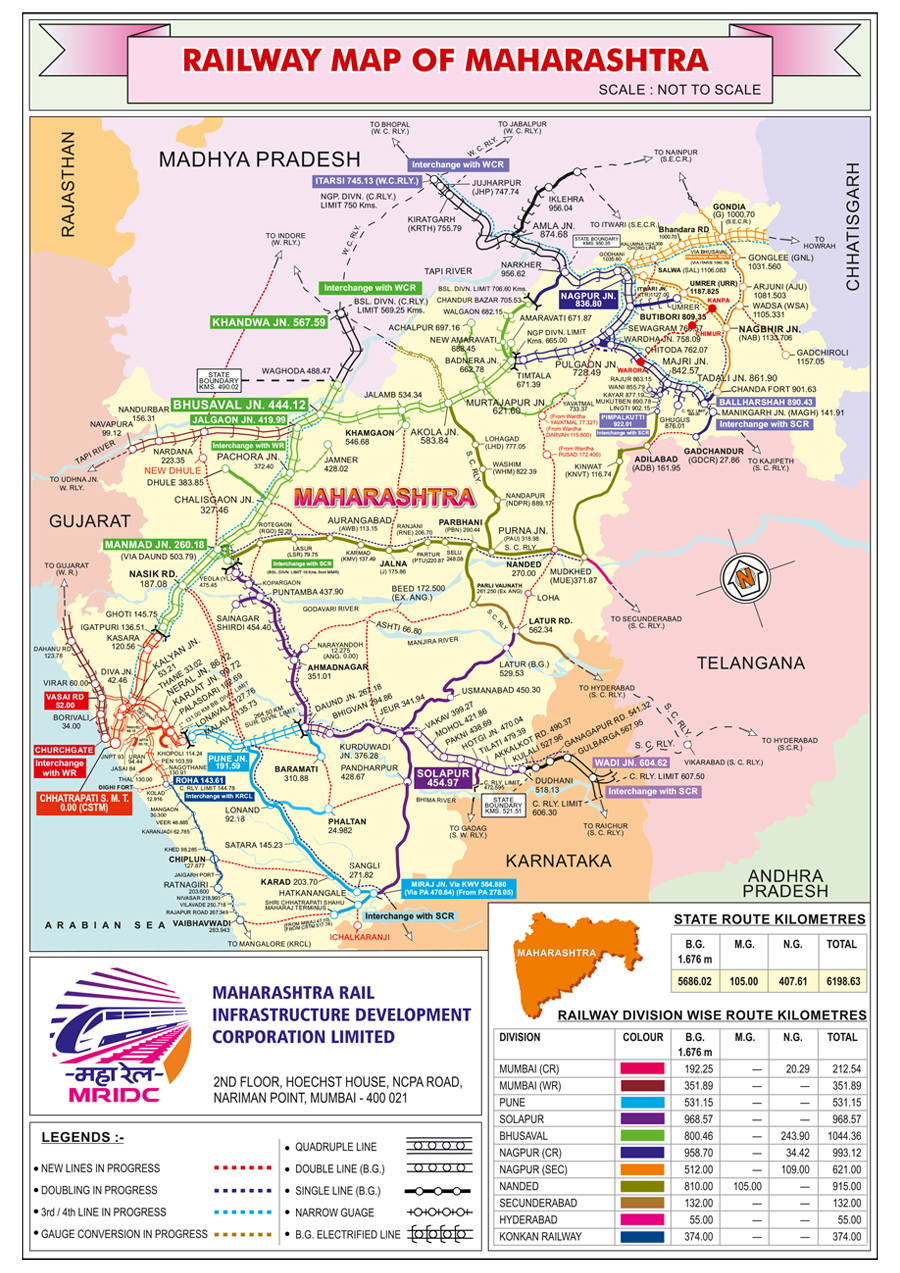
Over the past decade, Maharashtra’s railway sector has witnessed a steady growth, shaped by urbanisation, freight demands, and regional aspirations for improved connectivity. The recent announcement by Union Minister Murlidhar Mohol regarding the introduction of the Pune–Rewa train via Jabalpur reflects the dual nature of railway development in Maharashtra — on one hand, it marks progress in addressing long-neglected routes, while on the other, it underscores ongoing regional imbalances in rail planning and connectivity. While the new route offers long-overdue relief to passengers from western and central India, connecting Pune to Jabalpur through Rewa, it also reignites discourse over regional prioritisation and infrastructure equity within the state. This Info-Pack examines the structural landscape of Maharashtra’s railway network, its geographical spread, administrative coordination under various zones, and the scope of recent developments. At the same time, it addresses the systemic challenges – ranging from neglected regions like Marathwada and Vidarbha, to bottlenecks in suburban capacity and last-mile freight connectivity. Balancing expansion with efficiency remains key to ensuring that Maharashtra’s railway growth complements its broader economic trajectory.
The persistent demand for a direct rail link between Jabalpur and Pune arises from steady passenger traffic fueled by diverse needs such as professional commitments, educational pursuits, tourism, and administrative travel. By introducing this new service, the government is addressing a crucial gap in inter-state connectivity, offering enhanced convenience to thousands of commuters. Beyond its immediate benefits for travellers, this development highlights the expanding role of Maharashtra's railway network as a key contributor to India's overall rail infrastructure and its ongoing modernization.
Reflecting this broader growth, Maharashtra’s railway network has steadily expanded, reaching 5,861 km in 2022 — an increase from 5,823 km in 2021. This continuous development aligns with the national momentum in rail infrastructure enhancement. To put it into perspective, Maharashtra alone accounts for approximately 8.54% of India’s total railway route length, which stood at 68,584 km in 2023, underscoring the state’s significant position within the country’s rail connectivity landscape.
Maharashtra’s Railway Transformation: 2014–2024
Over the past decade, Maharashtra has witnessed an unprecedented transformation in its railway infrastructure under the Modi government. The railway budget allocation for the state in 2024–25 alone stands at ₹15,940 crore — 13.5 times higher than the UPA-era average of ₹1,171 crore (2009–14).
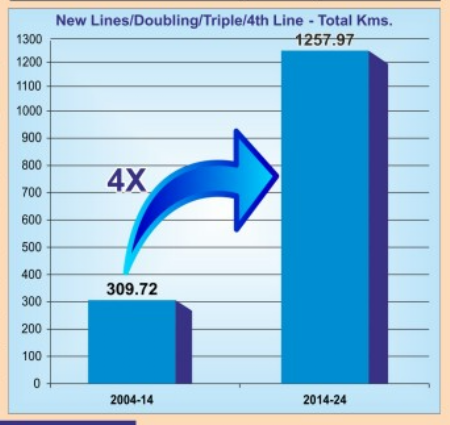
Between 2004 and 2014, under the UPA regime, the state saw a sluggish addition of just around 310 km of new railway lines, reflecting a lack of urgency and vision in infrastructure development. In contrast, the NDA government dramatically accelerated progress from 2014 to 2024, adding nearly 1,258 km — over four times the previous decade’s growth. This massive increase has translated into ground-level execution across three key areas: new lines, doubling of existing lines, and the addition of third and fourth lines.
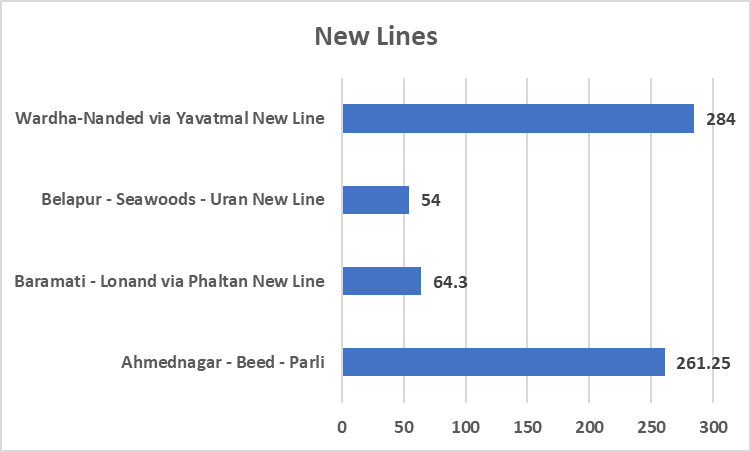
New Railway Lines (663.55 km)
Ahmednagar–Beed–Parli: 261.25 km
Baramati–Lonand via Phaltan: 64.3 km
Belapur–Seawoods–Uran: 54 km
Wardha–Nanded via Yavatmal: 284 km
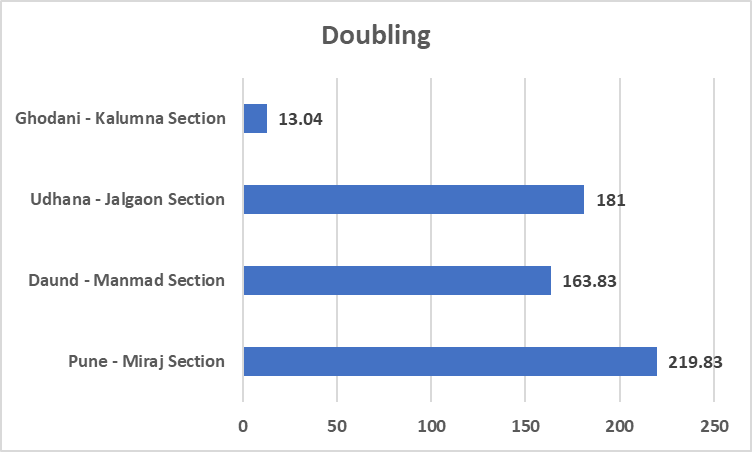
Doubling of Lines (577.7 km)
Pune–Miraj: 219.83 km
Daund–Manmad: 163.83 km
Udhana–Jalgaon: 181 km
Ghodani–Kalumna: 13.04 km
The Gondia-Ballarshah doubling project, spanning 240 km, was approved with an investment of ₹4,819 crore. This project holds strategic importance as it connects the Vidarbha and Marathwada regions, aiming to alleviate congestion and facilitate faster movement of both passengers and freight.
Two additional major multi-tracking projects, Ratlam-Nagda and Wardha-Balharshah, covering 176 kilometers across Maharashtra and Madhya Pradesh, were approved with a combined estimated cost of ₹3,399 crore.
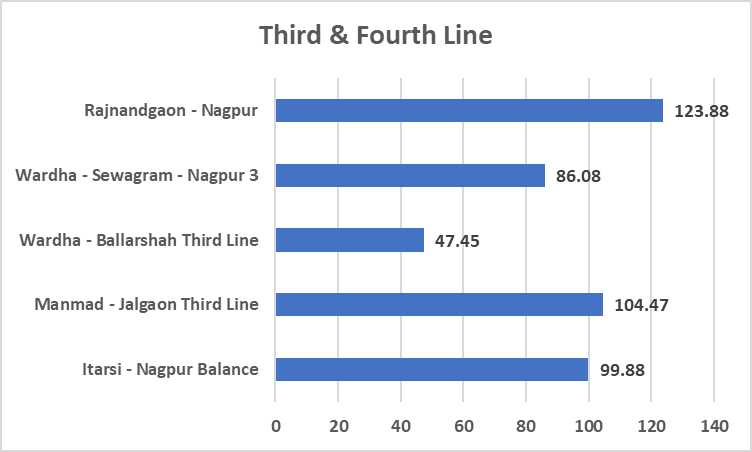
Third and Fourth Lines (461.76 km)
Itarsi–Nagpur: 99.88 km
Manmad–Jalgaon (Third Line): 104.47 km
Wardha–Balharshah (Third Line): 47.45 km
Wardha–Sewagram–Nagpur: 86.08 km
Rajnandgaon–Nagpur: 123.88 km
Source: Indian Railways Electrification
Maharashtra has made impressive strides in railway electrification, with 94.4% of its rail network now fully electrified. This achievement underscores the state’s commitment to sustainable and efficient rail transport. Notably, the Central Railway and Western Railway zones have reached a landmark milestone by achieving 100% electrification across their entire Broad Gauge networks
From enhancing passenger mobility to boosting freight corridors, these expansions reflect a clear prioritization of regional connectivity and economic growth. The scale and speed of execution in Maharashtra’s railway network are proof of a shift from policy paralysis to mission-mode delivery.
Currently, 47 rail projects worth ₹1,58,866 crore are underway in Maharashtra, including four new cabinet-approved projects, the Dedicated Freight Corridors, and the Mumbai-Ahmedabad Bullet Train project.
Mumbai-Ahmedabad High-Speed Rail Project, spanning 508 km and designed for speeds up to 320 km/h, aims to reduce travel time between the two cities to just about two hours. In Maharashtra, the 156 km stretch includes four stations — Mumbai (BKC), Thane, Virar, and Boisar — with Mumbai HSR station being the only underground one, currently under construction with six 415-metre-long platforms and direct connectivity via a 21 km tunnel (including 7 km undersea) to Shilphata. All civil tenders for Maharashtra — including the 135 km elevated section, four stations, a rolling stock depot in Thane, and the tunnel — have been awarded, and work is underway. Construction has commenced at all elevated stations, and tunnelling is progressing using Tunnel Boring Machines and NATM methods, with depths reaching up to 114m below Parsik Hill, marking a significant advancement in the nation’s first bullet train corridor.
Suburban, urban, and freight connectivity: The enhancement of Maharashtra's railway network extends well beyond main lines, with significant strides in suburban, urban, and freight connectivity. The Mumbai Suburban Railway, handling over 5,000 passengers per 9-car train during peak hours, is being upgraded under the Mumbai Urban Transport Projects (MUTP Phases 1–3), with key additions like the Virar-Dahanu quadrupling and Panvel-Karjat corridor. ₹1,777 crores was allocated for 2025–26 — up 125% from last year — for AC rakes, Kavach 5.0 signaling, and expanded services. Pune is also seeing major investments, including the ₹300 crore station remodelling project, new platforms, the Pune-Nashik semi-high-speed line (265 km), and upcoming double/triple line expansions toward Ahmednagar and Lonavala. Meanwhile, Nagpur Metro’s 38.2 km network with 37 stations, operational since 2019, reflects the growing emphasis on urban rapid transit, supported jointly by the Centre and Maharashtra government.
Modernisation of Railways in Maharashtra
Amrit Bharat Stations
New Train Services
Introduction of Eight Vande Bharat Express trains in Maharashtra. The major routes include: Mumbai to Shirdi, Solapur, Jalna, Madgaon; Nagpur to Bilaspur and Indore.
Coach Modernisation
Vista Dome Coaches
Revamp of Rajdhani and Shatabdi Express trains.
Bharat Gaurav Trains
To promote the rich cultural and religious heritage and concepts of "Dekho Apna Desh" and "Ek Bharat, Shreshtha Bharat", the First Bharat Gaurav Tour from Maharashtra was Dakshin Darshan Yatra in 2023 from Pune with 610 passengers. From then on, 16 trips of Bharat Gaurav Trains were operated from Maharashtra benefitting 9,052 passengers.
Regions still lacking railway connectivity and pending sanctioned projects
Despite Maharashtra’s vast railway network, regions like Vidarbha, Marathwada, Aurangabad, Amravati, and interior Konkan suffer from poor rail connectivity, contributing to socio-economic backwardness.
Key Delayed Projects:
Reasons for Delays:
Way Forward: Programmes such as PM Gati Shakti aim to bridge the gap, but effective execution and targeted regional development are essential to avoid widening disparities.
By strategically addressing these challenges and implementing these recommendations, Maharashtra can further solidify its railway network as a powerful engine for inclusive economic growth, ensuring that the benefits of enhanced connectivity reach all corners of the state.
Maharashtra's railway network is undergoing a transformative phase of modernisation and expansion, marked by strategic investments and infrastructure upgrades—particularly over the last decade. Suburban lifelines like Mumbai’s rail network are also being overhauled with enhanced infrastructure. However, sustaining and accelerating this momentum requires political stability and a clear vision. Significant progress was made when Devendra Fadnavis provided stable governance and ensured seamless coordination with the Centre. In contrast, the development pace faltered during the unstable tenure of the Uddhav Thackeray-led government. Today, with a more aligned and development-focused state government in place, there lies a vital opportunity to bridge Maharashtra’s deep-rooted regional disparities in railway connectivity — especially in underdeveloped areas like Vidarbha, Marathwada, and interior Konkan—and truly unlock the state’s holistic economic potential.
So it seems like there are many people who travel regularly between Pune-Jabalpur.https://t.co/EPBwo3e32G Problem is that there are many more areas which needs more attention, which needs more routes. You still haven't told me how many times you travel between Pune-Jabalpur. As a Punekar, I don’t need this Jabalpur train. Pune struggles with traffic, water shortages, water logging etc. Worst situation of Pune-Kolhapur Highway and many more. Why prioritize MP over local needs? Focus on Pune’s infrastructure—Wagholi, Katraj face daily issues. https://t.co/68V0kCbQCK 🚆 Big news! Pune-Jabalpur-Rewa train is coming soon, boosting travel & trade! 🎉 Students, tourists & biz travelers, rejoice! 🚉 More details awaited. #PuneJabalpurTrain #IndianRailways Pushing the horizons of design and freight delivery, Indian Railways launches a 1500 tonnes, 110.5m Rail Flyover Girder at Kalamboli, Maharashtra, on the Western Dedicated Freight Corridor, its longest yet and a feat of engineering brilliance. pic.twitter.com/uW8p6TUA6e 🚨Indian Railways launches longest rail flyover girder on western dedicated freight corridor at Kalamboli in Maharashtra. pic.twitter.com/c4euK60eTBIntroductory Memo
I can tell you that hundreds of ppl travel between Pune-Kolhapur, Pune-Solapur, etc routes but still they..
Read more: https://t.co/CcOgasDMsG pic.twitter.com/3lPvpyjR0e