On September 2, the Delhi High Court denied bail to Umar Khalid, Sharjeel Imam and others in the 2020 anti-Hindu Delhi riots larger conspiracy case.
Within minutes after passing the cue by leftist lobby, the self-anointed “liberal intellectuals” were painting Umar as a freedom fighter, Sharjeel as a misunderstood philosopher, and Narendra Modi as the world’s biggest tyrant. According to them, justice in India has been murdered, democracy buried, and dissent criminalized.
But let’s pause here. Is this really the truth… or just another script from the liberal playbook? Take Umar Khalid for example. The man who is paraded as a victim of a cruel judicial system actually sought adjournments seven times, only to finally withdraw his own bail plea. Yes, you heard that right — he pressed pause on his own case, and then the cabal cried victimhood. Now tell me, why would a genuine seeker of justice do that? Unless, of course, the plan was never to seek justice, but to create noise.
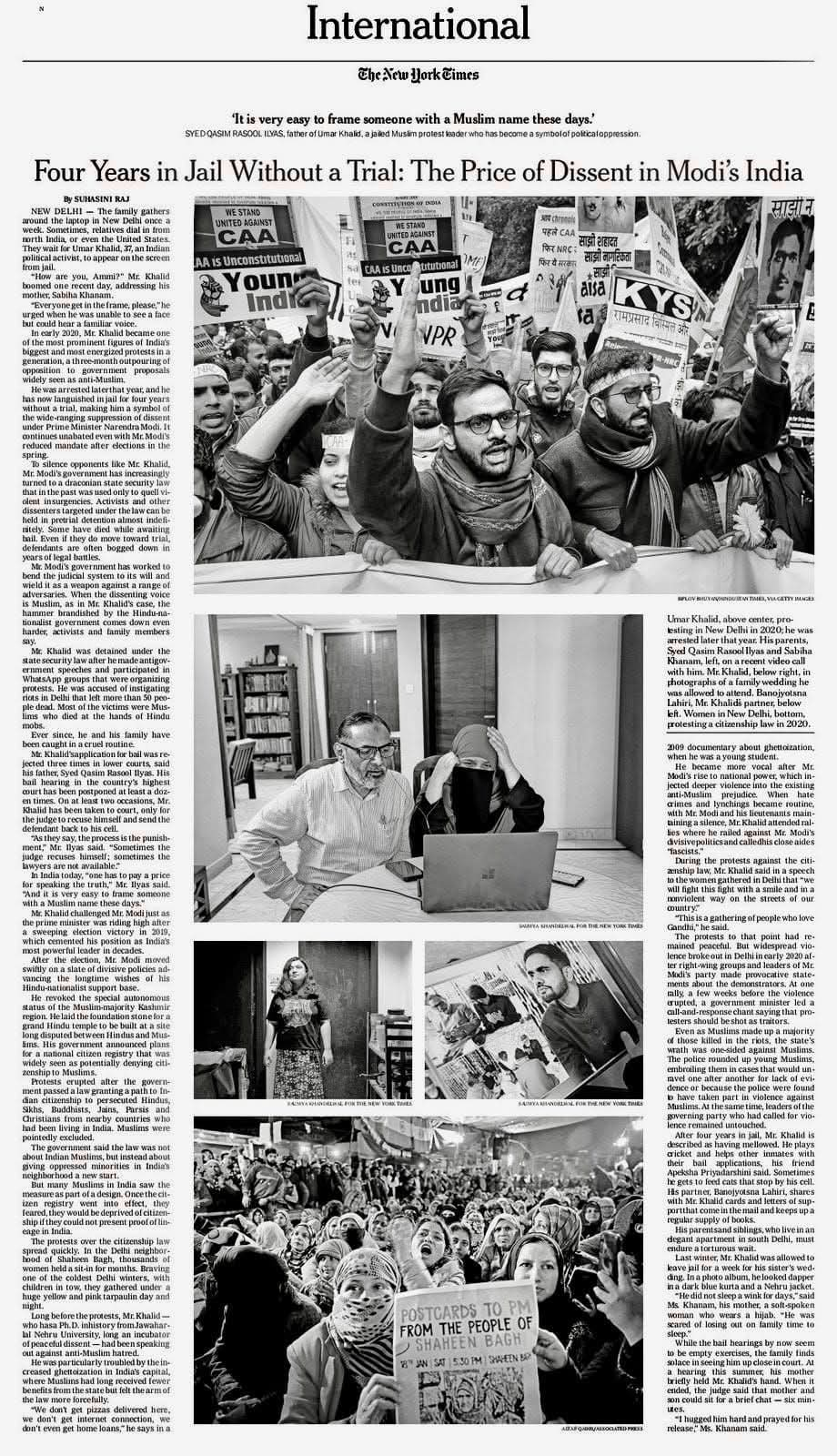
This is not about democracy. It is not about dissent. It is about manufacturing chaos, blackmailing the government, and painting India as an anarchic state in the eyes of the world. This is the new political toolkit of the liberal ecosystem—twist the facts, weaponize lies, and play the eternal victim. US newspapers carried big stories, describing that Umar Khalid was denied justice.
Table Of Contents
1. Analytical View
If you want to decode the narrative game, start with the lead actors—Umar Khalid and Sharjeel Imam.
Umar Khalid – Former JNU student leader, projected as a “political prisoner” by the Left-liberal brigade. In reality, he is one of the accused in the Delhi riots conspiracy case. His speeches during the anti-CAA protests weren’t about peaceful dissent—they were carefully worded provocations. He called for “street resistance” and “direct action,” phrases that conveniently turned into violence on the ground.
Sharjeel Imam – The man who made headlines by openly suggesting that the North-East should be cut off from India by blocking the Siliguri Corridor. Yes, the famous “chicken’s neck” speech. He wasn’t talking about a traffic jam — he was fantasizing about choking India’s lifeline.
Both men are celebrated in liberal circles as victims of fascism. But their own words show otherwise. They weren’t defending democracy; they were provoking disorder.
Since their arrest, the left-liberal ecosystem has been playing dirty to shield Umar Khalid and Sharjeel Imam. But unlike earlier attempts where multiple conflicting narratives were floated, this time they’ve chosen one script—to paint them as helpless “victims” denied bail by a vindictive Modi government.
Umar Khalid filing plea in Delhi High Court during the 2020 anti-Hindu Delhi riots larger conspiracy case.
But here’s the catch: that script was not exposed by politicians, but by the judiciary itself.
In a recent interview with Barkha Dutt, former Chief Justice D.Y. Chandrachud didn’t mince words—he took names and laid the truth bare. Without hesitation, he pointed to the repeated adjournments and delays in Umar Khalid’s bail petition, making it clear that these were not failures of the judiciary but deliberate tactics by the defense team.
Each time, instead of presenting arguments, the defense asked for more time. And when the case finally came to a stage where it could be fully argued, the petition was quietly withdrawn.
Between October 2023 and February 2024, Umar Khalid’s legal team—led by none other than Senior Advocate Kapil Sibal—turned the Supreme Court into a stage for strategic delays. Fourteen hearings were listed. Seven were adjourned—by choice. This wasn’t about caution. It was about choreography. A narrative was being written, not inside the courtroom, but for public consumption: that of the helpless activist, trapped in judicial inefficiency, crushed under the weight of a sluggish system.
Sharjeel Imam appearing in court during the 2020 anti-Hindu Delhi riots larger conspiracy case. Source: Vayuveg News Media
Umar Khalid and his legal team appearing before the Delhi High Court for bail hearings. Source: Vayuveg News Media
By February 2024, the bail petition was suddenly withdrawn. Sibal spoke of a “change in circumstances.”. The drama had served its purpose. Time to move back to the trial court and repackage the story. The optics were perfect—months of adjournments, timed withdrawals, and media megaphones. The message? Khalid, the martyr of a judiciary.
But here’s the crack in the script: if delays were truly the issue, why did Khalid wait six long months after the Delhi High Court’s October 2022 rejection before even approaching the Supreme Court in April 2023? Was the system slow — or was this deliberate foot-dragging to build a victimhood narrative?
Forum Shopping: The Bench-Hunting Game
Adjournments weren’t the only trick. Khalid’s team played the oldest game in the book: forum shopping in which a litigant lands before a bench “sympathetic” to their cause.
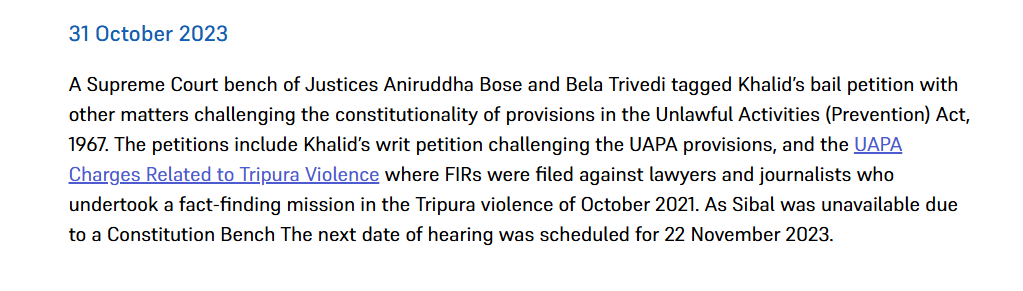
Forum shopping is the practice of a litigant deliberately choosing a specific court or jurisdiction out of multiple available options with the hope of obtaining a more favorable outcome for their case. First, they tried tagging the bail plea with other UAPA cases to create a cluster effect. When that didn’t click, they pushed for de-tagging and reassignment. Letters flew, arguments piled up—all in search of the “right” judge.
By December 2023, the theatrics were out in the open. Prashant Bhushan shot off an angry letter to Chief Justice DY Chandrachud, fuming that Khalid’s bail plea had been listed before Justice Bela Trivedi. Dushyant Dave and Abhishek Manu Singhvi joined the chorus. Singhvi even hijacked a Satyendar Jain bail hearing to cry foul, calling it “irregular.”
CJI Chandrachud didn’t blink: “It is very easy to fling allegations and letters,” he said dryly. SG Tushar Mehta added a sharper line: the best response to such letters was to simply ignore them.
The Comedy of Adjournments
But the adjournments kept rolling in:
January 17, 2024: Adjourned because the ASG wasn’t available.
January 24, 2024: Kapil Sibal asked for another adjournment. Naturally, it was granted.
The same day, before Justices Bela Trivedi and Ujjal Bhuyan—the counsel found yet another reason to stall. And the court obliged.
If this fight was truly about justice, Kapil Sibal and his team would have stepped into the courtroom, argued the case, tested the evidence, and awaited a judgment. That’s how justice is sought. But what did we actually see? A playbook straight out of political theatre: delay hearings at every opportunity, shift the blame onto the judiciary, withdraw petitions at will, and then sprint to the waiting arms of the media with cries of “political persecution.” It wasn’t a legal battle; it was a carefully scripted drama designed not to win in court, but to win in headlines.
This was never just about Umar Khalid’s bail. It was about something far bigger — the systematic attempt to delegitimize India’s institutions. The playbook is predictable:
attack the judiciary when verdicts don’t go your way, brand the government authoritarian when laws are enforced, and then reverse course—praise the very same system when a favorable order comes through. It’s a cycle of selective outrage, designed not to strengthen democracy, but to hollow it out. The ultimate goal is clear: erode public trust, create chaos, and paint the image of a broken Republic.
Former CJI DY Chandrachud confirms what I had written about Umar Khalid’s bail application in SC. I had written that 7 times, it was Khalid who sought adjournment, ultimately withdrawing application. The cabal later played victim.
-Supported Burhan Wani -Supported Afzal Guru -Raised Bharti tere tukde slogans -Wanted Kashmir to be free -Conspired Delhi riots in which many innocent Hindus were kiIIed
He's being presented as an "innocent rebel student leader" by INDI alliance ecosystem.. pic.twitter.com/IMUp3clXdb
Now even Rajdeep Sardesai, one of the most compromised journalists of our times, has admitted that Umar Khalid and his counsel Kapil Sibal were actively engaged in “bench hunting” and “forum shopping”.
"Kashmir is illegally occupied by India" - Umar Khalid
Umar Khalid isn’t some “student leader” or “activist.” He speaks the same language Pak does about Kashmir. He openly raised slogans in support of Afzal Guru, the Parliament attack conspirator whose hands dripped with the… https://t.co/PyywcD0bcQpic.twitter.com/wowl2gHwzP