Lesson from murder of Delhi’s Hindu youth
Background
On Monday, March 9, the Delhi Police arrested around eight Muslim persons, including a minor, in connection with the brutal murder of 26-year-old Tarun Khatik in southwest Delhi’s Uttam Nagar. Earlier, the police arrested seven persons in the case, bringing the total number of arrests today to 14, including two minors. According to the Delhi Police, the latest arrests include Sayra alias Kali (40), Sarifan (50), Salma (36), Suhail alias Sahil (21), Sameer Chauhan (20), Firoj (22), and Ismail (50), all residents of Uttam Nagar.
The recent murder of a Hindu in New Delhi's Uttam Nagar is becoming the talk of the town after the New Delhi Police initiated the arrests, though delayed, following the massive protests from the Hindu community in the area. The Municipal Corporation of Delhi (MCD) also initiated the bulldozer action on the evening of March 8, on the illegal properties of one of the accused, identified as Nizammudin. Why was Tarun Khatik targeted and beaten to death? Who provoked the accused Islamists to kill Tarun? Why did the police delay action in the case? Here's all that you need to know-
Incidents of targeted attacks by Islamists on people celebrating Hindu festivals have become a new normal over the years. This year as well, several incidents of attacks on Holi celebrations were reported from different areas, even internationally. However, the recent incident in Delhi managed to send shock waves across the entire community nationwide. The brutal story unfolded on the night of March 4, 2026, in the Uttam Nagar area of Delhi. What triggered the accused Islamists to kill Tarun was the festival of Holi, which the so-called leftists and liberals have been targeting, sometimes raising voices over the alleged wastage of water, and sometimes claiming harm to the environment in various ways.
An 11-year-old Hindu girl in the area on the day of Holi was playing with the colors and water-filled balloons on the terrace of her building. She happened to throw a water-filled balloon from the terrace at her father, Ramesh, who was standing below the house. However, as the water splashed on Ramesh, it also unintentionally splashed on a woman identified as Sayra, who was also standing below the house. This sparked the initial communal confrontations, after which Ramesh and his father Mann Singh apologized to the Islamist woman and explained that the act by the minor girl playing on the terrace was unintentional. However, the woman created a ruckus and informed her family members, complaining that she was allegedly targeted by the Hindus. Following this, her family members gathered around the house of Ramesh and began abusing him.
The deceased, Tarun, meanwhile, was away from home playing Holi with his mates in the neighboring area. As per the reports, when Tarun returned home that night and turned his motorcycle into the lane where his family had lived for nearly fifty years, eight to ten Islamists were already waiting. They were armed with rods, sticks, and stones. His uncle Ramesh, later, while talking to the media, said Tarun had no idea what was about to happen; he had just come home.
The Islamists attacked him brutally, beating him until he collapsed. Even after he fell and could no longer move, the assault continued. His grandfather later recalled watching in horror as one of the attackers picked up a heavy stone and hurled it onto Tarun’s chest. Tarun was 26 years old and was studying digital marketing. According to his family, the house had been filled with joy earlier that day, almost like a wedding celebration, because they had much to look forward to. However, the environment turned tragic after Tarun was beaten and succumbed to his injuries the next morning at Mata Chandan Devi Hospital on Thursday, March 5.
Tarun’s father spoke to reporters outside the hospital. He said there had never been any major conflict between the two families before. They were neighbours who had lived side by side for years. Like many families in a crowded colony, they sometimes had small disagreements over water, parking, or shared space, but nothing that had ever turned serious. He described his son as someone who avoided trouble. Tarun was focused on building a future for himself. He was taking courses, working on plans, and trying to move forward in life. He was only 26.
The father repeatedly stressed on one point: Tarun had not even been involved in the earlier argument. According to him, the matter had already been settled. Yet when his son returned home, he walked into a lane where a group of men was already waiting with weapons. It was difficult for him to understand how things could have escalated so far. The question he seemed to ask again and again was simple: how could this happen?
Both families originally came from Rajasthan and had lived in Hastsal’s JJ Colony in southwest Delhi for nearly fifty years. However, anyone who has grown up in a dense Delhi neighbourhood knows that relationships between neighbours are rarely perfect. They can be complicated, shaped by old grievances, misunderstandings, and the daily friction of living close together. But the distance between those everyday tensions and what happened to Tarun Khatik on the night of March 4 is vast.
At some point, that distance was crossed. A group gathered, weapons were brought out, and someone decided that the earlier apology was not enough.
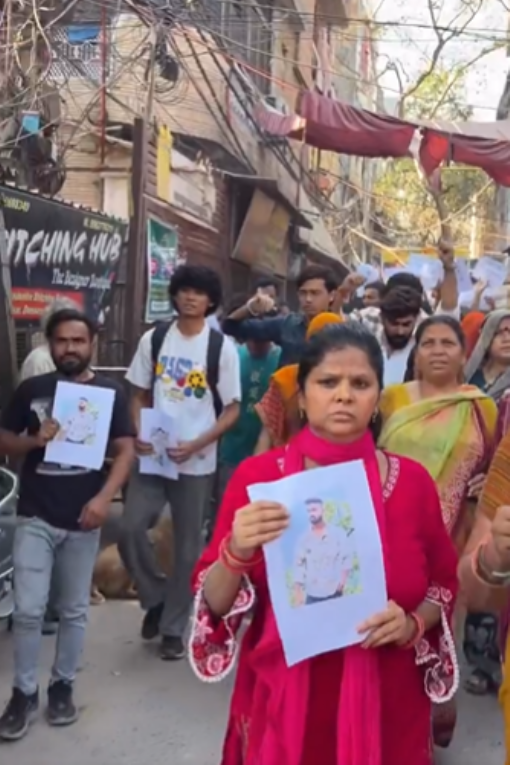
After the incident happened, several Hindus began protesting against the Islamist attack and demanded the immediate arrest of the accused Islamists in the given case. The locals claimed that the police deliberately delayed action to allegedly save the accused individuals. This was also widely picked up on social media as the Islamist family in question managed to flee from the spot after learning about Tarun's death. However, on March 7th, the Delhi Police initiated 8 arrests, including a minor.
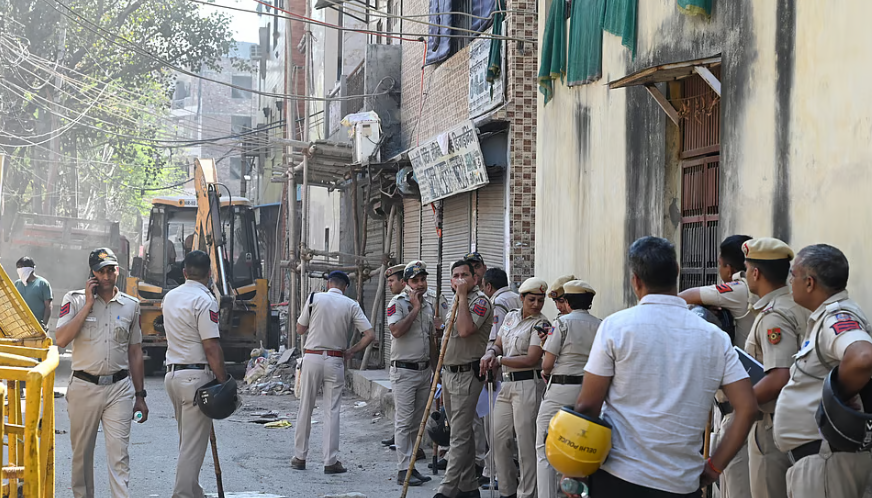
Since then, the police have been moving fast, at least in terms of apprehensions. An FIR was also registered in the case, imposing the charges of murder against the Islamist family, among others. And on March 9th, the Police arrested an additional 7 persons, including another minor. Notably, Sayra, the woman on whom the balloon water splashed, was also arrested by the Police Monday. DCP Dwarka Kushal Pal Singh confirmed that security forces, including paramilitary units, are deployed throughout the colony and that CCTV footage from the area is being examined. Additional DCP Niharika Bhatt was careful to note that injuries occurred on both sides and that investigators are still working through the complete timeline before concluding.
Hindu groups played a major role in pushing the police to take action
After the incident sparked outrage, a massive army from the Bajrang Dal and VHP marched in a peaceful protest in the Uttam Nagar area of Delhi. They raised slogans and sat in the road and refused to move as traffic piled up on both sides, and the police deployed drones overhead to track what was happening on the ground, instead of arresting the fleeing accused.
It is also claimed that the enraged protestors and locals set the house of one of the accused on fire; however, the facts in this incident remain widely unconfirmed. Also, a car and a motorcycle inside JJ Colony were set on fire. Following this, the shops in Hastsal Colony pulled their shutters, forcing the residents to stay inside. On social media, things were worse in a different way: posts were spreading with the wrong name for the victim, distorted timelines, and language calibrated specifically to make people angrier than they already were.
Notably, the police swung into action to identify the victims and process their arrests. So far, 14 people belonging to the Muslim community have been arrested. The Municipal Corporation of Delhi (MCD) also, on 9th March, 2026, executed a bulldozer action against the illegal property of one of the accused, identified as Nizamuddin, arrested in the case.
Politics around the death of an innocent
Delhi BJP president Virendra Sachdeva on Sunday condemned the violence that took place in Uttam Nagar on the day of Holi and welcomed the action taken by Delhi Police and the Municipal Corporation of Delhi to demolish the allegedly illegal house of the family accused in the murder case. Sachdeva said extremists had inflicted many such wounds on the mothers of Delhi in the past as well, but what happened this time was extremely brutal. He said that after such a heinous act of violence and murder, the strict action taken by the police and administration would serve as a strong lesson for extremists in the future.
Earlier, on Saturday, CM Rekha Gupta had condemned the killing of a 25-year-old man during Holi celebrations in Uttam Nagar, calling the incident “heartbreaking and reprehensible” and assuring strict action against those involved. In a post on X, Gupta said Delhi has a zero-tolerance policy towards violent crimes and directed authorities to ensure the immediate arrest of all accused and swift action in the case. “This brutal murder of an innocent youth in Uttam Nagar, Delhi, on the auspicious occasion of Holi, is extremely painful, condemnable, and shocking for the entire society. Delhi has a zero-tolerance policy for such heinous and violent incidents. Such brutality will not be tolerated at any cost,” Gupta said.
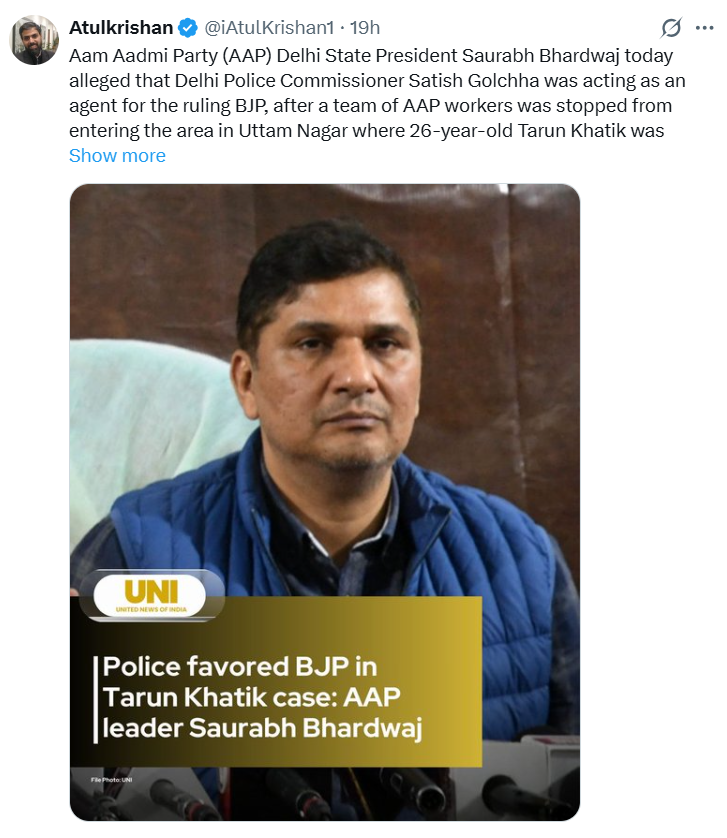
Meanwhile, the Aam Aadmi Party (AAP) on Sunday alleged that its leaders were stopped by Delhi Police from meeting the family of Tarun Kumar, who died during the clash in Uttam Nagar during Holi celebrations. Taking to X, AAP Delhi president Saurabh Bhardwaj claimed that while Delhi Police stopped him from meeting the victim’s family, around 20 BJP workers were allowed to go inside in front of him. He said the incident took place in the presence of media personnel.
“On the day of Holi, Tarun was murdered, and the victim’s family is accusing the police. Today, we reached Uttam Nagar to meet the family, but the Delhi Police stopped us and allowed the BJP workers to go ahead of us. Everything happened in front of the media,” he wrote on X.
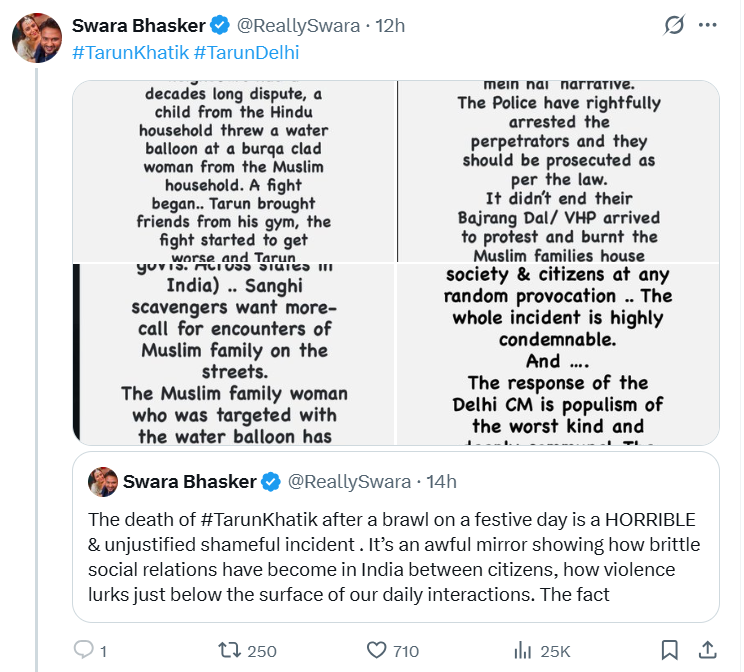
Targeting the ruling government and the Sangh unnecessarily, a former actor who has a history of supporting the leftists, Swara Bhasker took to X to share her unwanted opinion on the whole scenario. In multiple notes, she re-wrote what the incident was, and how, according to her, the whole scenario has become 'political opportunism.'
"The whole Sanghi ecosystem is in overdrive about the murder of one #TarunKhatik in a Holi brawl with his Muslim neighbors. It's a messy story. The Delhi police confirmed that the neighbours had a decades-long dispute, and a child from the Hindu household threw a water balloon at a burqa-clad woman from the Muslim household. A fight began. Tarun brought friends from his gym, the fight started to get worse, and Tarun sustained a head injury, causing him to collapse. His friends ran away. People from both households were hospitalised. Tarun died the next day in the hospital. It's HORRIBLE and a totally avoidable death (sic)," she claimed.
She further wrote about how headlines were made that a Hindu man was killed by a Muslim mob, and a narrative of 'Hindu Khatre Mein hai' was created. The actress also mocked Delhi's Chief Minister Rekha Gupta for reportedly ordering that the Muslim family's house should be bulldozed.
Swara further wrote, "Sanghi scavengers celebrate the bulldozing of Muslim homes (totally illegal as per Supreme Court orders banning bulldozer justice, widely disregarded by BJP govts. Across states in India).. Sanghi scavengers want more- call for encounters of Muslim families on the streets. The Muslim family woman who was targeted with the water balloon has now put out a statement alleging that she was molested and harassed by drunk men, including Tarun, after the balloon incident, and that's why the fight began (sic)."
Islamists deliberate hate towards Hindu Dalits: Identifying the pattern
Violence against Dalits remains a persistent social issue in India. While much of the documented violence historically involves caste oppression by dominant groups, there have been several incidents where Hindu Dalits have been attacked by members of other communities, especially Muslims, particularly in localities where communities live in proximity. Such incidents have sent shockwaves across the Hindu community, exposing the deliberate intent and hatred of the Islamists towards the Hindus.
Recently, on 24th February, 2026, 12 individuals from the Muslim community attacked Dalit Hindus during a Kuaan Poojan and Devi Jagran programme in Bulandshahr locality of Uttar Pradesh. According to the reports, the Muslims attacked Dalit Hindus over the DJ music during the programme. A case was registered on the complaint of one of the victims, Akash Kumar, against 64 individuals, including 15 named and 50 unnamed persons, under the BNS and the SC/ST Act.
In the Saharanpur district of Uttar Pradesh, people from the Dalit community accused a Muslim mob of attacking them with weapons and brutally assaulting them. It was also alleged that the accused hurled casteist abuses at them and threatened to kill them. During the attack, the accused also targeted a woman. 3 people suffered serious injuries in the attack and were admitted to the hospital.
Based on the complaints of the victims, the Police registered a case against 5 accused, including Ishaq, Sahil, and Asghar. The incident took place on 9th August 2024 in the home district of Bhim Army chief and MP Chandrashekhar ‘Ravan’.
In Peepalsana, Moradabad, which is a Muslim-dominated locality, the Muslim barbers refuse to give haircuts to Dalits. “If Dalits take a haircut and shave in these shops, the towels will become dirty. How will other Muslims take haircuts after that?” questioned Naushad, a barber.
In January 2018, a Dalit girl accused a Muslim youth of forcibly trying to convert and marry her. When she resisted the same, the youth and a few of his associates kidnapped and gang-raped her for a week. As per the girl, the accused even recorded a lewd video of her.
In Durveshpur village of Sardhana, Uttar Pradesh, a minor conflict between some people belonging to the Dalit and the Muslim communities escalated into communal violence. People from both communities came face to face, and heavy stone pelting and firing took place. The incident happened in February this year. Several people from both sides were injured due to stone pelting and the exchange of fire
Recurring patterns can be observed in the crimes listed above or similar crimes in which Hindu Dalits are deliberately targeted by the hands of the Islamists. Notably, the involvement of Muslim women in hate crimes against Hindus appears with concerning frequency in several such incidents. They appear to be perfectly willing to indulge in hate crimes against Hindus. Their consent can also be gauged from the fact that not a single woman from the community has made any effort, even in history, to report people from their own community when they have indulged in mob violence. Hence, it’s of critical importance that we do not consider Muslim women as victims of an ‘Islamic Patriarchy’ because quite clearly, they do not perceive themselves as such.
Another troubling pattern is the participation of large sections of the local community in these acts, along with visible support for those accused of wrongdoing. In the given case also, the individual to get triggered over the unintentional incident was a woman named Sayra. Despite, the father and grandfather of the victim issuing an apology, the woman called her relatives and claimed blatantly that she was allegedly harassed by the Hindu neighbors, resulting in the death of Tarun.
Such developments suggest that education alone may not be sufficient to bring about meaningful reform within the community. If substantial sections continue to receive financial benefits or state assistance while simultaneously offering tacit or open support to such misconduct, it risks creating a perception that such behaviour carries no real cost. In the absence of accountability, the incentive for change becomes weak.
We’re building something amazing. We’re building something amazing. We’re building something amazing.
Introductory Memo

🚀 Coming Soon
🚀 Coming Soon
🚀 Coming Soon